

Natural Capital
Realizing Our Mission
As part of the series of capability building sessions we held in 2022, we engaged Pi Energy to deepen our understanding of energy use, efficiency, and management. We held a webinar between Pi Energy and the subsidiaries, followed by Level 1 Energy Audits of their facilities. The engagement with Pi Energy also prepared the subsidiaries on their compliance with Republic Act 11285 or the Energy and Conservation Act of the Philippines.
Energy efficiency as the “first fuel” was impressed upon the subsidiaries, emphasizing the importance of first optimizing the current use of energy in their facilities. The following were the results of the audits and next steps identified by the business segments:
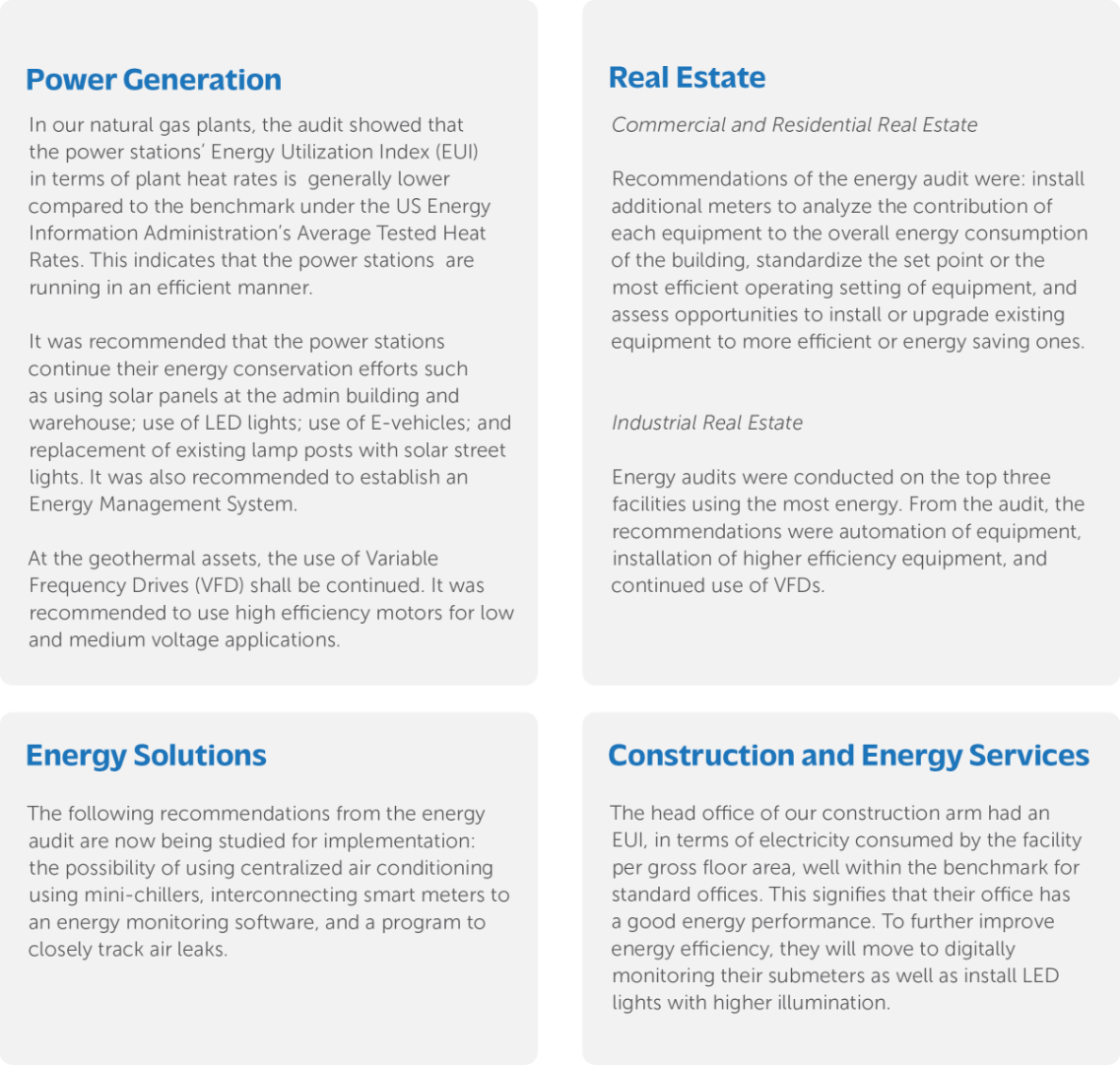
The recommendations and improvements resulting from this engagement will inform the energy management initiatives of our subsidiaries in 2023 and the following years. The initiatives will be revisited every three years consistent with the national regulation.
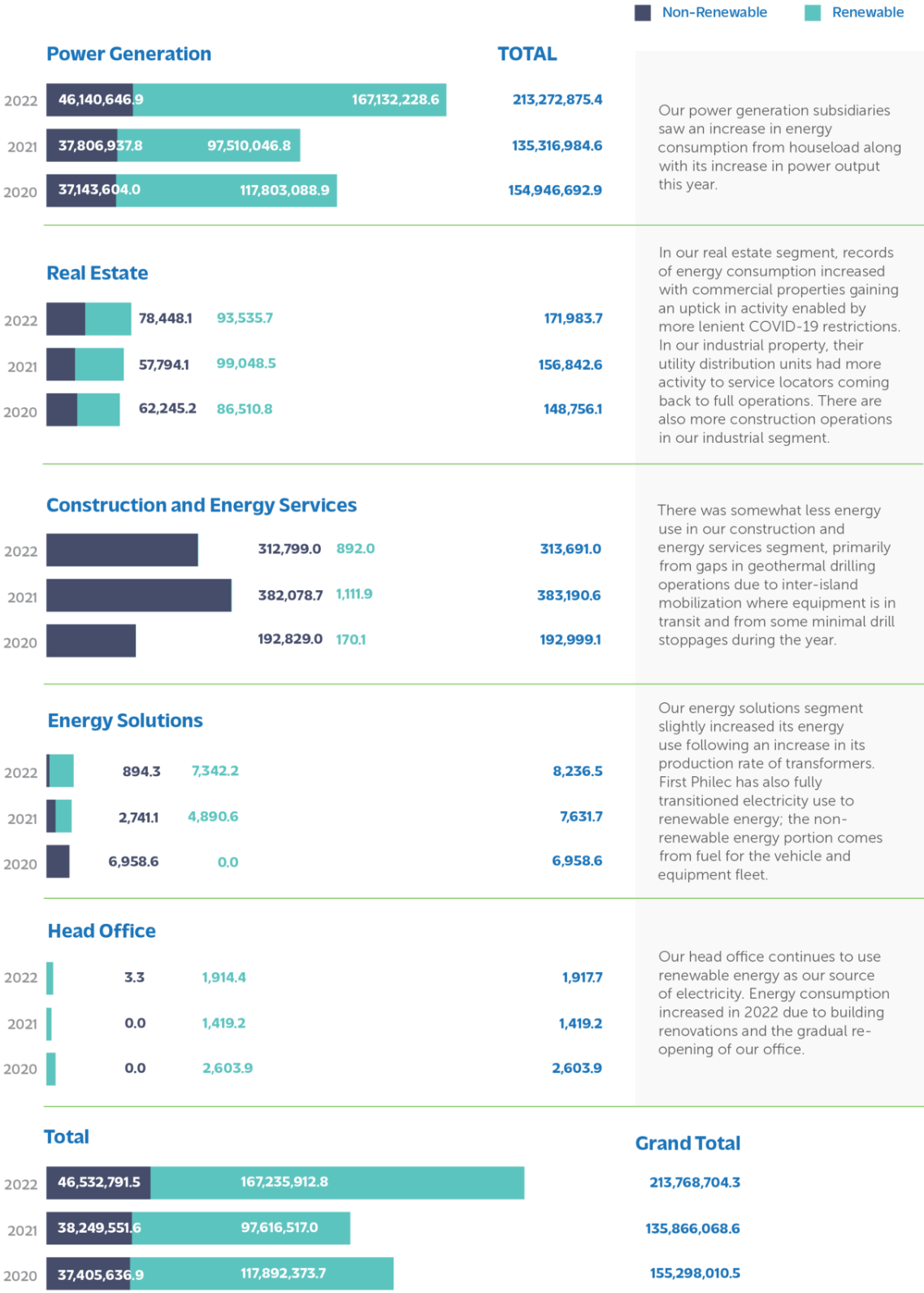
Energy Use in our Business Segments
GHG Emissions and Management
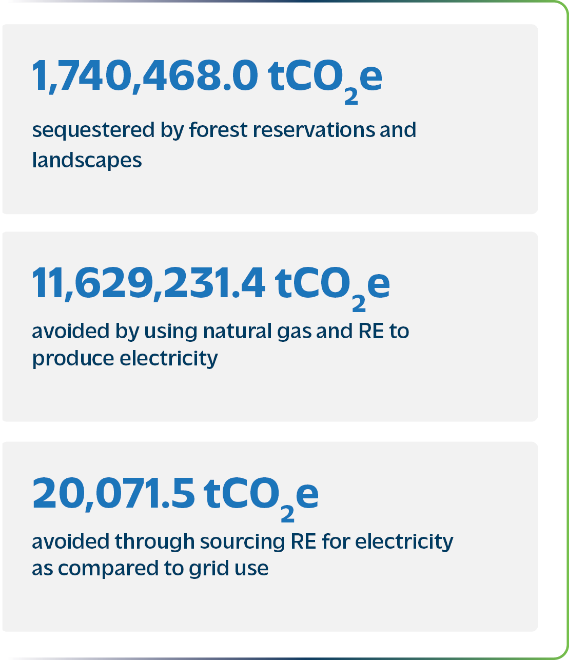
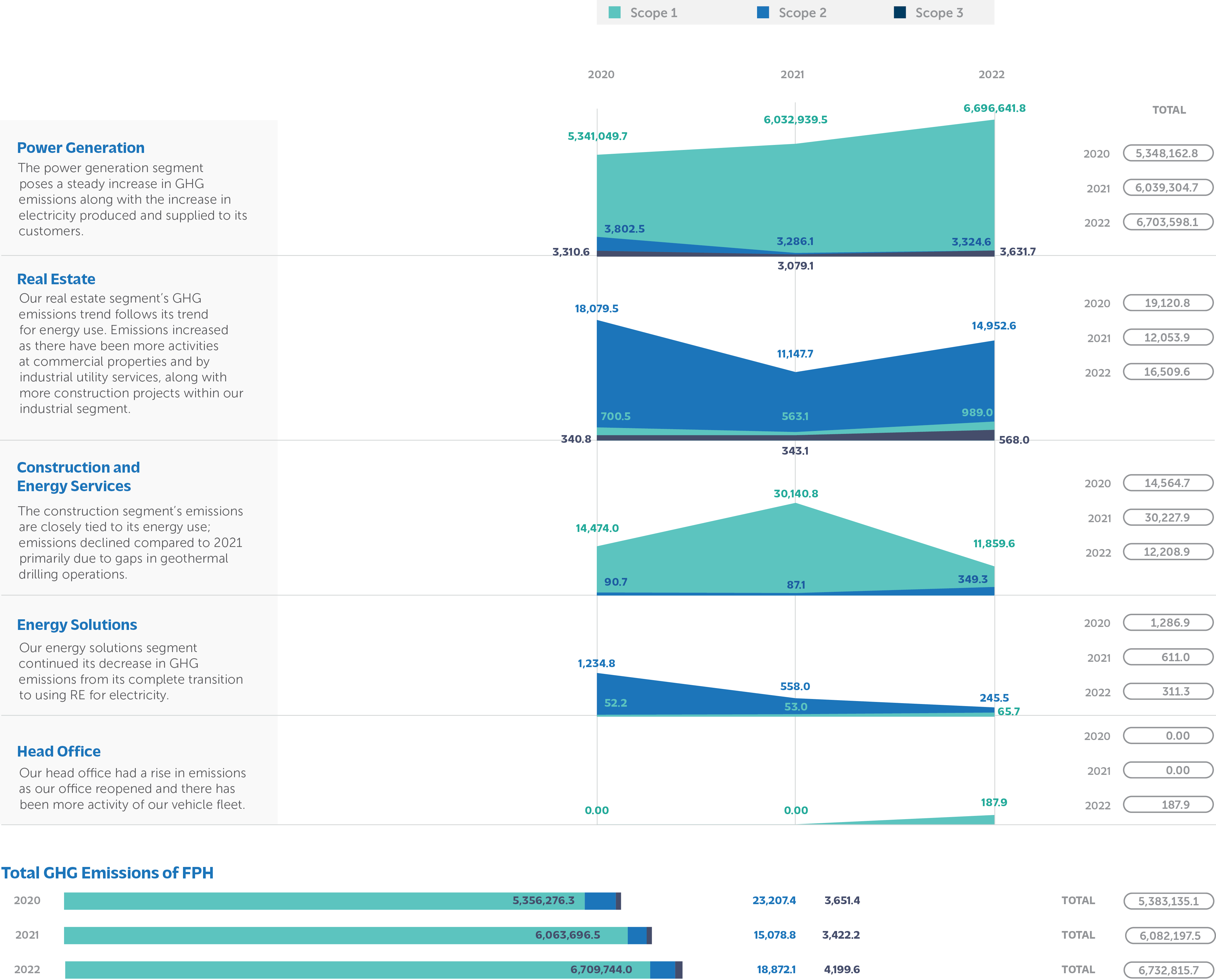
As mentioned in the section on our TCFD developments on page 66, we conducted a series of sessions on the topic of decarbonization with the goal of each subsidiary developing their strategies to reduce emissions and aim for net zero. The earlier section on how we are progressing on our mission, on pages 80-82, details the decarbonization plans of our businesses and the general pathway of FPH. The following section presents our GHG emissions and the trend for the past three years. To summarize, our emissions are strongly linked to our energy use, particularly the use of energy from non-renewable sources.
Our power generation businesses are our leading sources of emissions as we continue to increase our capacity and generation. The use of natural gas and liquid fuel remains the biggest contributor to our overall emissions. Our geothermal assets also contain some amount of carbon dioxide in its steam, though emissions from geothermal are around one sixth than that produced by coal-fired power plants. With regards to our non-power generation businesses, the trends in emissions generated vary according to each subsidiary’s activities. For all business segments, energy efficiency plans and a decarbonization roadmap have been initiated as we commit to progress on our mission for decarbonization.
Nevertheless, we note that the growth of FPH may see an increase in our carbon intensity. But this is as we work to lower the overall carbon intensity of our customers and the country. The increase in capacity of our natural gas projects will be alongside the transition of other industries away from coal and will aid in the current intermittency issues of renewable energy. We are also still growing our RE projects to increase the RE capacity available for the country. On the side of our non-power generation businesses: increased activity in our energy solutions segment translates to better efficiencies of energy distribution grids and an ability to influence customers on green solutions; the growth of our real estate businesses, particularly into integrated communities, hopes to serve the needs of communities in regenerative ways; and our construction segment will continue to be active in the development of key infrastructure for the country. We acknowledge that our role as a business will be in the service of our customers and stakeholders.
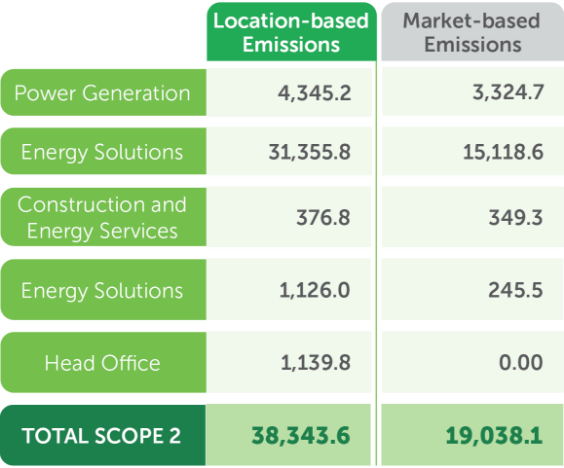
In this regard, our businesses strive to create an ecosystem of collaboration where we can work with our stakeholders to reduce greenhouse gas emissions. In particular, the availability of RE and the ability to source it through the Green Energy Option Program (GEOP) of the government is instrumental in bringing down the scope 2 emissions of our subsidiaries. This is especially important for our real estate segment.
The following are the initiatives of our subsidiaries on this front:
In our residential and commercial real estate subsidiary, Rockwell Land transitions its properties to sourcing energy from RE when possible. Though currently this is met with difficulties with regards to the availability of supply. Through their many properties sourcing RE, they are able to also bring down the emissions of their tenants.
In our industrial real estate subsidiary, FPIP has transitioned three facilities to partner with a geothermal power provider to source their electricity. Part of their emissions reduction program is to transition more facilities to RE.
Apart from their own operations, all new commercial properties in the pipeline are embedding the use of solar panels and rainwater collection systems in the design.
For their locators, they partner with an energy service company and highly encourage locators to avail of their services for better energy management. This is available for both existing and new locators within FPIP.
Torreverde Corp, the aggregates facility of First Balfour in Taysan, Batangas has begun to source part of its power from geothermal. First Balfour will also be expanding the capacity of their head office solar rooftop to another 100kW in 2023, thereby increasing the use of renewable energy for head office operations./p>
In our power generation businesses, EDC has begun a pilot to use electric vehicles fueled by steam energy. The pilot will determine how many units should be added to its vehicle fleet across the country. In First Gen, e-vehicle fast charging stations powered by solar panels have been installed. The e-vehicles are used for official business trips in their site in Batangas.
EDC launched an innovations program that includes looking into technologies to reduce carbon emissions from geothermal operations. Feasibility st
First Gen continues to implement the Methane Fugitive Emissions Management Program which started in July 2020. The program aims for early detection of gas leaks using an optical gas imaging camera, resulting in immediate rectification of leaks and reduction of fugitive methane emissions. Based on this program, recorded gas leaks in 2022 had a flow rate ranging from 0.197 to 0.954 cu.ft./hr. This is significantly less than the 6 cu.ft./hr standard of the US Methane Standards of 2016. Total fugitive methane emission at FGCEC was equivalent to 126.8 tCO2e, which is 98.17 percent lower than the 2019 baseline.
In our energy solutions subsidiary, First Philec’s facility now fully utilizes renewable energy, with about 23 percent of energy needs coming from their solar panels and 77 percent sourced from geothermal. Externally, through their customers, they contribute to reducing the emissions from electricity distribution by encouraging their customers to use more clean and efficient distribution transformers such as Amorphous Distribution Transformers (AMDT) or Biodegradable Distribution Transformers (BioDT).udies on technologies such as carbon capture and storage and carbon recycling are conducted by a multidisciplinary team.
GHG Emissions of our Business Segments
Scope 2 emissions, comparison of location-based and market-based
Unit: tCO2e
Other Air Pollutants
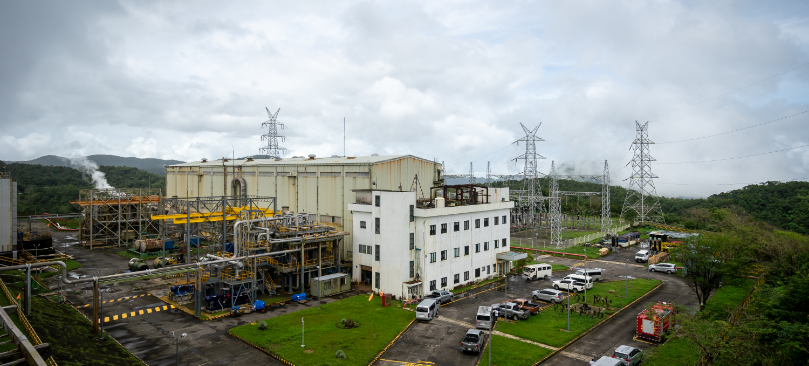
Our businesses emit other air emissions that include carbon monoxide, nitrogen oxides, sulfur oxides, and total suspended particulates. Most of these are emitted by the natural gas power plants of our energy segment, followed by the generator sets of construction and energy services segment for drilling geothermal wells, and the generator sets of our real estate segment used to provide backup power in case of power interruptions. All sources of air emissions are monitored and emission concentrations remain within allowable limits as prescribed by the national government.
Materials Use
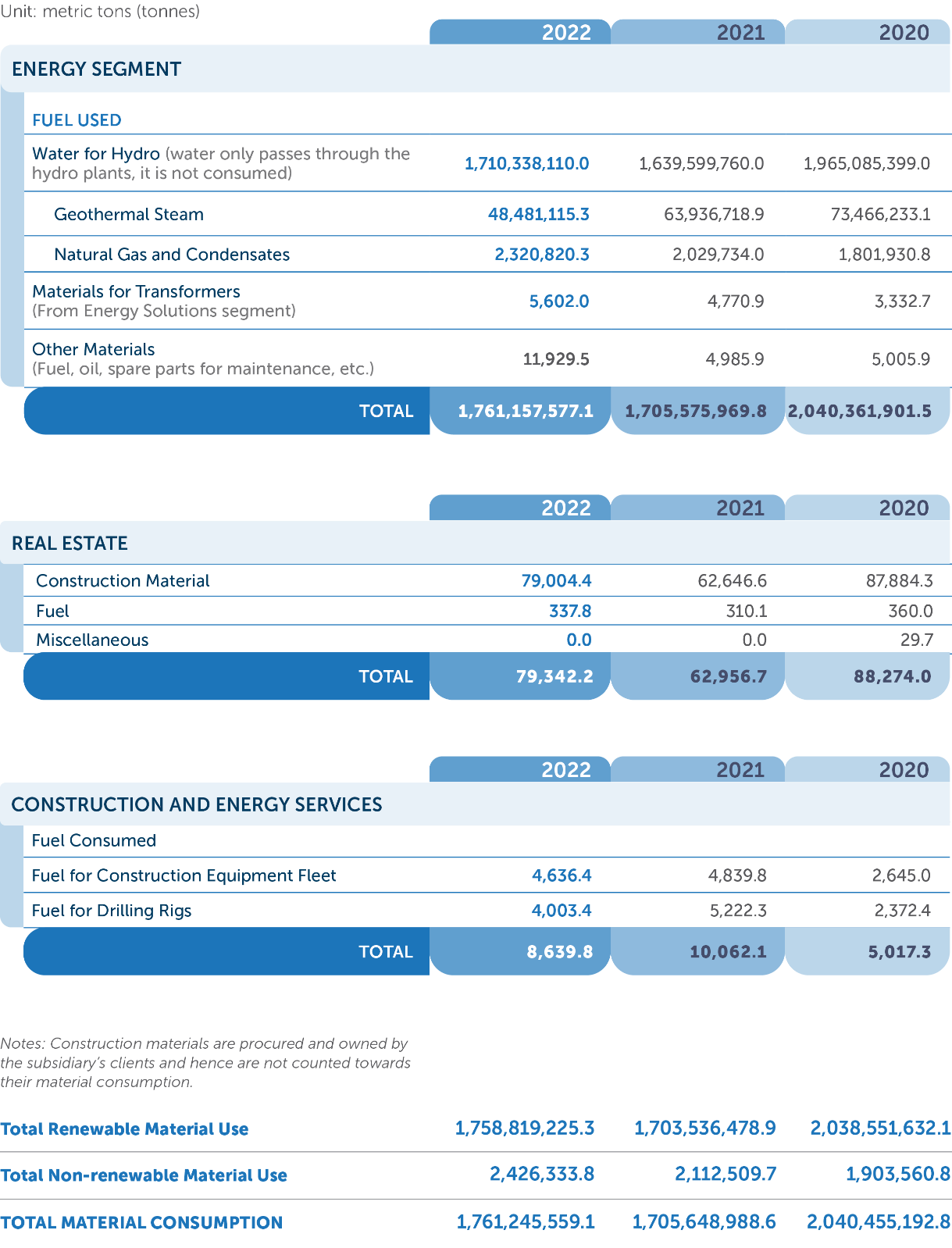
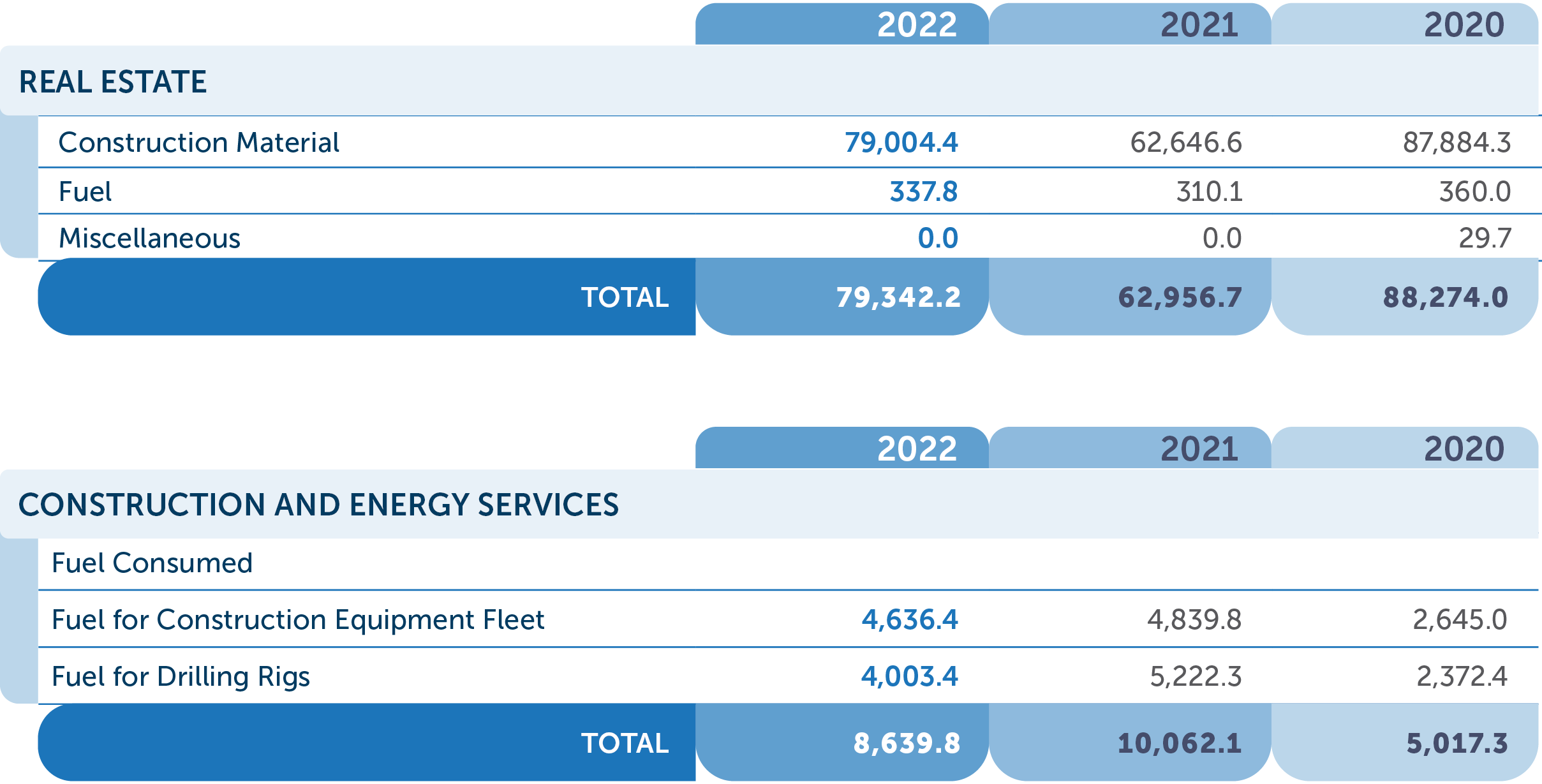
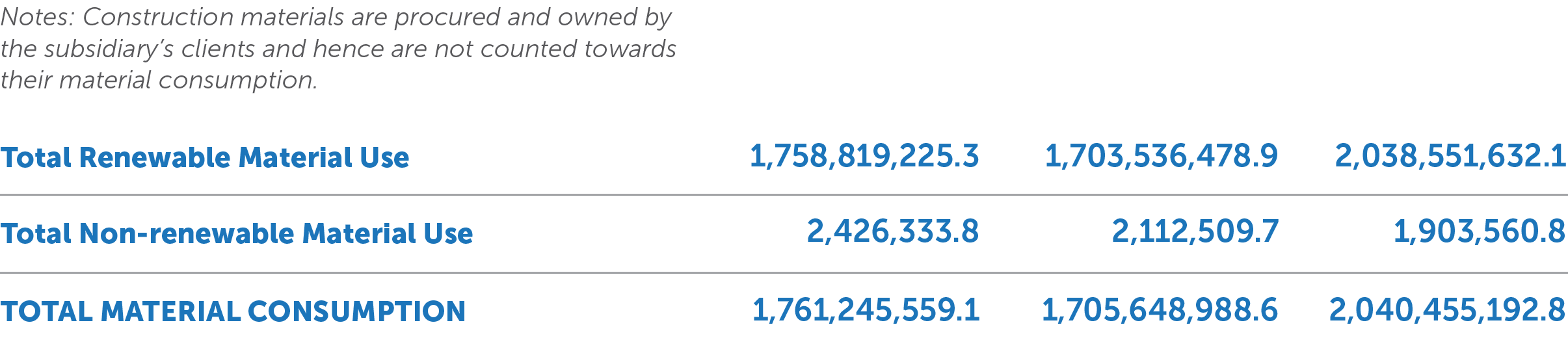
The materials used across our businesses increased in 2022 driven by an increased use of fuel for power generation. This was particularly for the natural gas plants and the hydro power plants, though water for hydropower plants merely passes through the system to drive the turbines. Our energy solutions subsidiary continues to increase its production of transformers, while our real estate segment catches up with construction projects following the easement of pandemic restrictions.
Waste Management
A lecture and workshop series on Waste Management was conducted in 2022 with the help of the UP National Engineering Center. The sessions covered topics from basic to advanced concepts in waste management, resource recovery, and the circular economy. Each lecture was accompanied with a workshop with the experts wherein the subsidiaries could immediately contextualize the concepts discussed, assess their current practices, and initially identify solutions to enhance their waste management plants. Facilities of the subsidiaries were also assessed by UP NEC to identify further improvements.
From the sessions, the subsidiaries resolved to fill in any gaps they identified in their processes, strengthen internal policies and practices, and build partnerships and collaboration—particularly for the recycling, reuse, recovery, or diversion of waste; and ultimately for a circular economy.
As the wastes being handled by the business segments can be specific to their industry, each subsidiary set out their path to strengthen their waste management programs.
Power Generation
Majority of the identified activities for waste management centers on changing behavior. To succeed in the long-term goal of circularity, our power generation subsidiaries believe that employee engagement and organization-wide participation is essential. The following activities were identified:
- Improvement of the color coding for the waste segregation bins and provision of labels and visual aids
- Refresher training for employees on Waste Management Procedures
- Regular reminders to workers during tool box meetings
- Promotion of 5S and other housekeeping projects
- Policy on single-use plastics, along with strengthening management measures for alternative packaging;
- Launch of the “7 R’s of Environmental Regeneration”, which aims to educate, promote, and engage employees in adopting actions beyond recycling
- Increase partnerships with recycling companies
Real Estate
Residential and Commercial Real Estate
Rockwell aims to increase the percentage of operational waste sent to recycling facilities. To accomplish this, the following initiatives were identified:
- Reduce the waste input of offices with a transition to paperless documents, especially in regard to the various documents issued to tenants
- Conduct regular e-waste collection to properly dispose of electronic gadgets
- Partner with material recovery facilities and recycling companies
- Partner with organizations that aim to recycle cooking oil
- Analyze construction wastes that can still be recycled and partner with general contractors to ensure they will not be landfilled
Majority of the wastes generated by the properties originate from residents and tenants which are autonomous from Rockwell. Thus, these stakeholders were identified as important to engage and collaborate with in the goal to reduce and divert waste. Some initiatives for this segment are:
- Regular awareness campaigns to educate stakeholders on waste management
- Incentivize proper waste management
- Increase frequency of collection of special waste such as e-waste and hazardous waste
- Incorporate materials recovery facility in the building design.
Industrial Real Estate
FPIP’s long term target is a zero-landfill waste disposal, by properly segregating each waste type and partnering with organizations for the collection of scrap materials, food waste, hazardous waste, and recyclables. For residual waste, they will look into possible technologies or partnerships to process and divert this type of waste from landfills. The following initiatives are being done and being developed:
- Continued transition to paperless processes and setting up an online portal for locators to submit their various reports to FPIP digitally
- Create a comprehensive database that includes waste characterization and measurement to address the identified gap in data collection, monitoring, and classifying residual waste
- Improve and expand the materials recovery facility for better segregation
FPIP also understands its sphere of influence with its locators and aims to promote a circular economy with them. In 2022, they worked with an engineering consultancy firm for a study on potential waste management services for its locators.
Energy Solutions
First Philec is planning to set year on year reduction targets. Enhancements to waste management will be done through:
- Investing in the implementation of waste management standards, such as Environmental Management System of ISO 14001
- Continue to invest in the process automation and digitization initiatives
- Continue to facilitate co-creation activities with suppliers, contractors, and customers to foster sustainability to their respective operations
- To ensure that plans are executed well, needed capabilities and training will be provided to the relevant persons
Construction and Energy Services
From the Waste Sessions, our construction arm developed a work program to enhance their waste management practices. Activities include:
- Establishing a committee for the waste program
- Conducting a waste stream analysis
- Developing appropriate policies
- Conducting trainings
After these phases and the initial implementation, the waste management program will be reviewed to establish more specific objectives.
With regards to circularity, First Balfour signed a memorandum of agreement with The Plastic Flamingo Philippines to support sustainable plastic waste management efforts. Through this initiative, the First Balfour Head Office will serve as a private plastic waste collection hub.
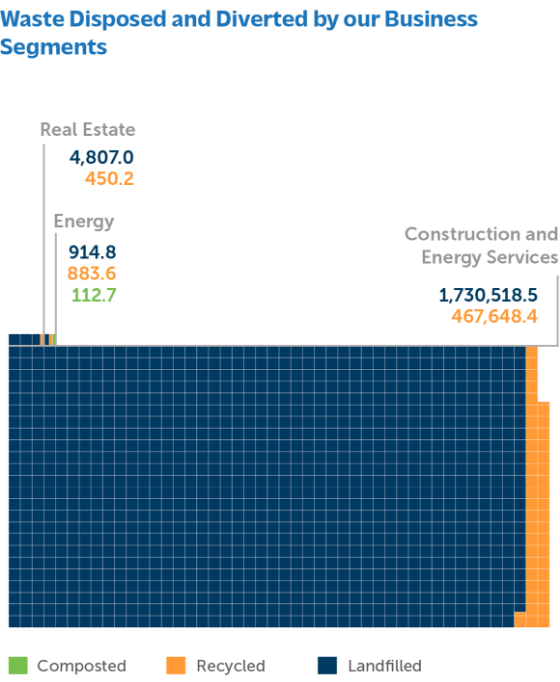
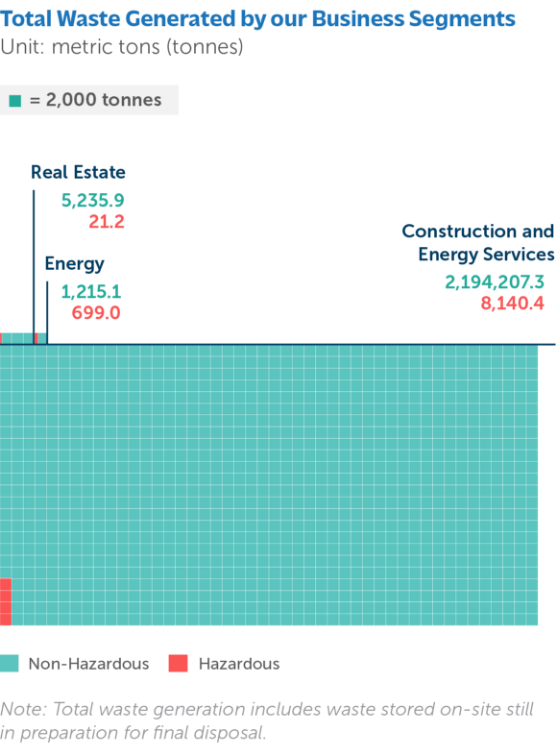
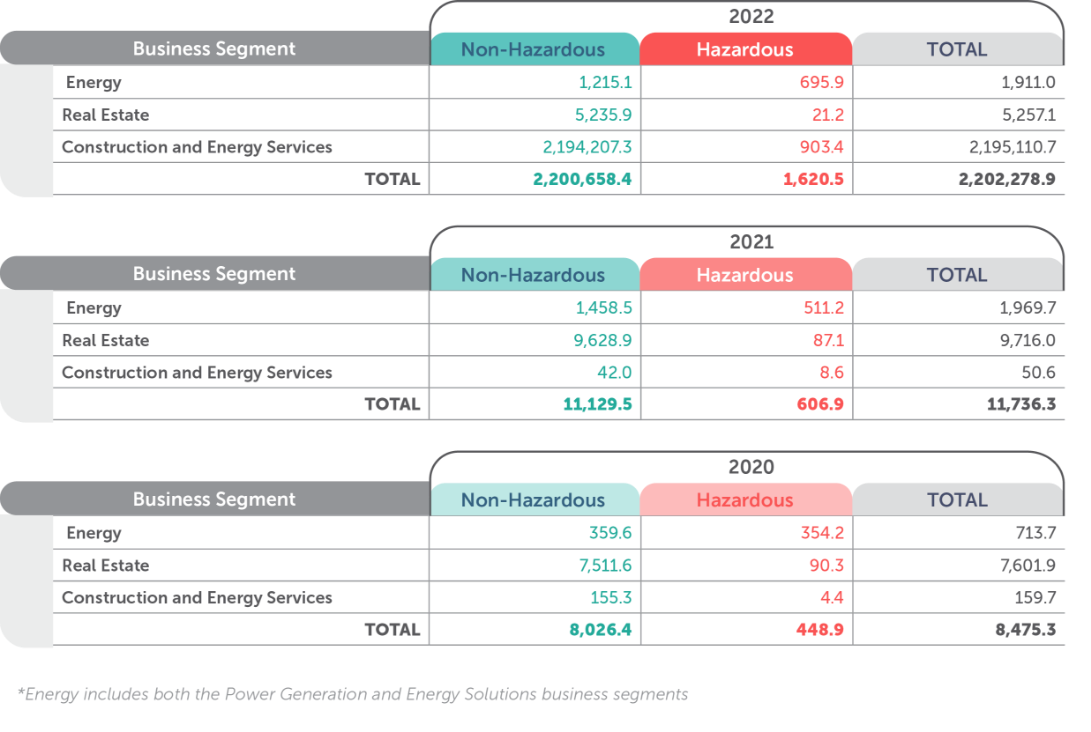
In addition to the establishment of objectives and metrics by the subsidiaries, there has also been improvements in how our waste data are recorded and monitored. Compared to 2021, the real estate segment shows a decrease in recorded waste generated due to taking better measurements of waste disposed; while in our construction segment there is a massive increase as they have included construction waste from their projects in their scope to have a better idea of the work that is to be done.
Water Management
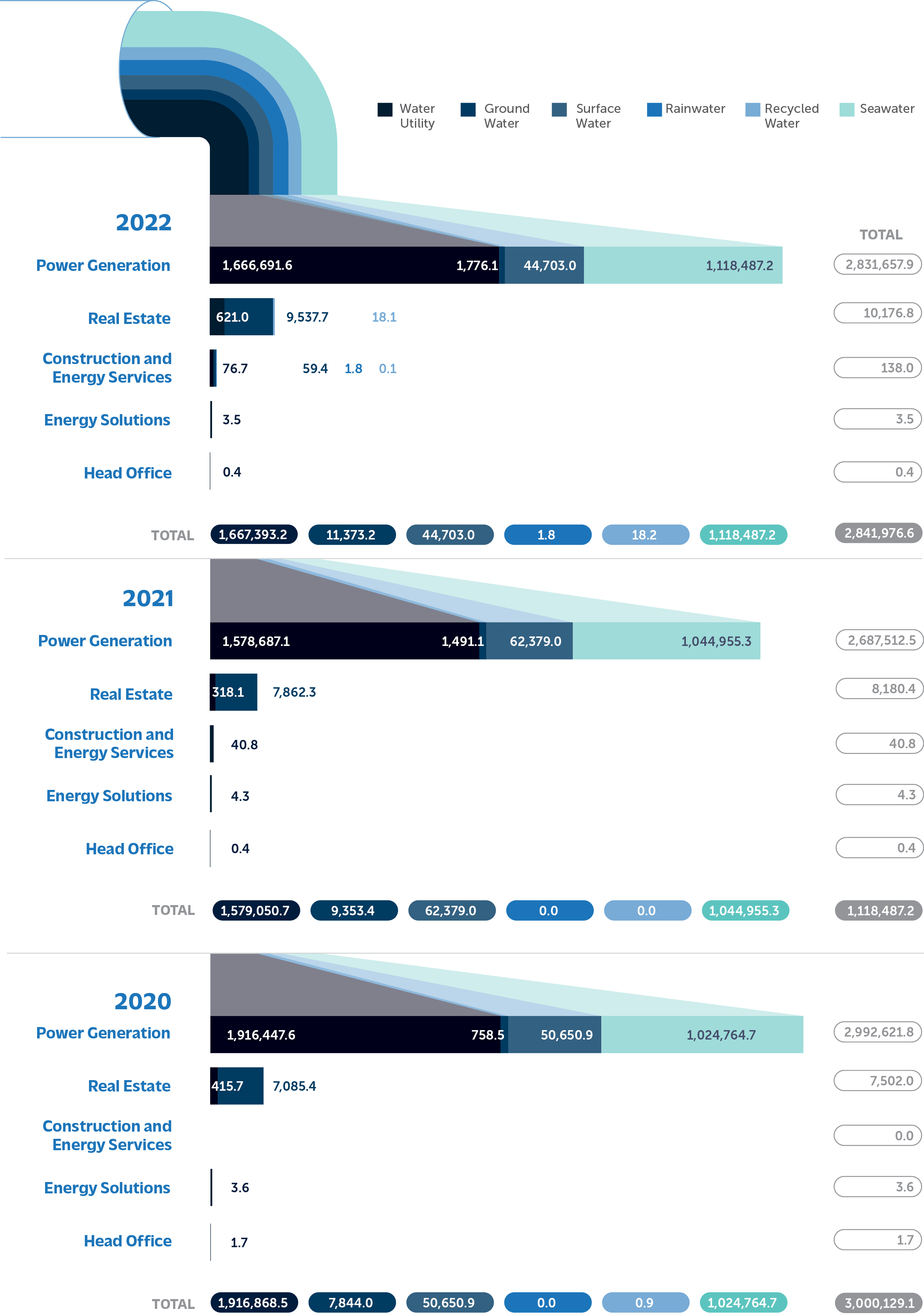
Our water use across FPH is mainly driven by the needs of the power generation segment: water that flows through the hydropower plants to produce electricity, seawater used for cooling the natural gas plants, and groundwater to cool geothermal plants if the use of geothermal brine needs to be augmented. Water for hydropower only passes through the turbines while seawater used for cooling also only passes through the natural gas plants in a non-contact cooling process. Both of these are returned to the environment with few changes in water quality. In the non-power generation subsidiaries, water is mostly used for domestic purposes such as in comfort rooms, pantries, and kitchens; and for irrigation of landscapes.
Our water use in 2022 increased, along with the increase in power generated by the energy subsidiaries. The real estate segment also had an increase in water use due to an uptick in commercial activities as well as with the inclusion of the air-conditioning system and chillers in the scope of data monitored. Our real estate segment is also targeting to increase the use of recycled water for irrigation in order to conserve water extracted from the environment.
In our industrial real estate segment, FPIP recognizes that water is an important resource that is fundamental to the sustainability and growth of their business. Given the findings from the comprehensive water study done in 2021, FPIP strengthened its focus on and capability in managing this resource by establishing the Water Resource Management Group. In 2022, the group proceeded with the recommendations from the water resource study. Additionally, they are also exploring alternative sources of water including but not limited to water reuse, rainwater collection, and water impounding with recharge. They are coordinating with the Laguna Lake Development Authority (LLDA) and the City Environment and Natural Resource Office (CENRO) for possible initiatives. FPIP also acknowledges that water consumption is mainly attributed to the locators and collaboration with them is key to the efforts on water conservation and management. With that, they have begun discussions on the topic of water reuse with some locators.
Water Extracted by our Business Segments
Unit: tonnes CO2-equivalents (tCO2e)
Wastewater Management
All our businesses comply with national and local regulations for the appropriate treatment of wastewater before its release to the environment. All of our offices produce domestic wastewater; this is collected and treated in the wastewater systems of the properties in which we hold office. In our real estate segment, each property has its own wastewater management system that treats the wastewater before release into the nearest bodies of water, in compliance with all pertinent regulations on effluent water quality. For our construction and energy services segment, wastewater from construction and drilling activities is managed by their clients. More details on wastewater treatment and its pathway for each of our business segments can be found on page 139 of our 2020 Integrated Report, available on our website.
Biodiversity and Habitat Protection
Of our major businesses, it is our power generation subsidiaries that operate in areas that are of ecological interest. These are our geothermal forest reservations across the country and our First Gas Clean Energy Complex (FGCEC) located in Batangas relatively close to the Verde Island Passage, a marine protected habitat. With their proximity to these areas and acknowledging that the health of these ecosystems are vital to our operations on site, our power businesses lead programs ensuring the integrity of nature in these areas. Because of the criticality of robust ecosystems in providing the raw material needs of our power operations, we support the emerging global framework of Task Force on Nature-related Financial Disclosures (TFND). Its prescriptions will guide us in integrating nature’s risks in our decision-making.
As the social aspect cannot be separated from the environmental aspect when caring for the environment, the programs led by our business cover both nature’s integrity as well as the welfare of host communities. This section details the accomplishments related to biodiversity and habitat restoration and management. The information on the social components of these programs are detailed in the section on Social and Relationships on pages 135-137.
Freshwater Protection
First Gen also continues its long-term partnership with DENR under the Adopt-a-River/Water Body Program. The program aims to protect and enhance the Cabubulag River in Brgy. Sta. Clara, Batangas City through regular water quality monitoring and cleanup activities.
Marine Protection
First Gen continuously supports the conservation and protection of Verde Island Passage (VIP) in partnership with the Provincial Government of Batangas, the Batangas Marine Protected Area Network, and Batangas Bantay Dagat Network (sea patrols). Through the network, 2579.0 hectares across 54 Marine Protected areas are conserved and protected.
Mangrove Reforestation
Located within the host barangays of Sta. Clara and Sta. Rita Aplaya of Batangas City, FGCEC continued to conduct mangrove reforestation activities in partnership with the community and with the fund support of First Gen employees.
Create for Climate
Education comes first in working with various stakeholders on environmental programs. The Create for The Climate (CFTC) project aims to instill environmental consciousness among the communities and partner organizations of First Gen. The coverage of this program includes First Gen’s host communities in Batangas, Nueva Ecija, Bukidnon, and Puyo.
In 2022, First Gen was able to engage eight municipalities for Local Climate Change Action Plan (LCCAP) orientation, one barangay to conduct a CTFC project, and four schools with online webinars. A specific component of CFTC is the “What’s Heating Up?” webinars for all types of stakeholders including employees, communities, customers, and partner organizations. Five of these webinars were conducted with participation of 413 employees and 337 individuals from external stakeholders.
From these engagements, seven climate action projects were implemented, resulting from an ideation activity and the CTFC with the barangay. From the implemented climate action projects, four were implemented by FPH employee groups.
Lobo Integrated Area Development
Lobo, Batangas has been a long-time community partner of First Gen in protecting the integrity of the Verde Island Passage. Beginning in 2021, it became the focus of concentrated and coordinated community development involving several organizations between FPH and the Lopez Group Foundation. This we call the Lobo Integrated Area Development (IAD) and we describe in detail on page 137. Community development comprises four clusters: Environment, Education, Children’s Rights and Development, and Social Enterprise and Livelihood. First Gen, EDC, and the ABS-CBN Foundation leads the Environment cluster of the Lobo IAD.
The environment cluster uses a Ridge to Reef approach which looks at the interconnectedness of different ecosystems from ridge, to the community, and to the reef. The activities of the environment cluster is a collaboration among the Lopez group organizations which are implementing environment programs and includes First Balfour, OML Center, and Sikat Foundation.
The following activities were accomplished in 2022 by this cluster:
- Establishment of an arboreta for native trees at the Batangas State University, Lobo campus
- Seagrass Monitoring Workshop and Reef Monitoring and Mangrove Tour Workshop with community members, to build up their knowledge and awareness for environmental monitoring
- Planting of mangrove seedlings at the Lagadlarin Mangrove Forest and Olo-olo Mangrove Forest
- Incorporation of science in development programs and education. Particularly there are two on-going initiatives: an adventure tourism platform targeting students and employees that will discuss the key to sustainability, and a carrying capacity study on the Lagadlarin Forest
- A grant was also received by our partners, this will be used to conduct the Citizen Science Reef Monitoring which will run for the next three years
BINHI Program
The BINHI program is our power generation segment’s major program for forest conservation, rehabilitation, and management. Led by First Gen’s subsidiary, EDC, activities under BINHI include forest protection, forest restoration, biodiversity conservation, mainstreaming Philippine native trees, and recently, a forest carbon project. The following were the accomplishments in 2022 under the EDC’s BINHI program:
Forest Protection
- Continue to protect 127,608 hectares of natural tropical rainforest within its 4 geothermal reservations
-
3,004.6km of foot patrols and drone flights in the reservations, focusing on conservation areas.
- In 2022, they updated forest patrol plans for each project site
- 4 apprehensions with DENR
- No forest fires reported in 2022
- Creation of the Multi-sectoral Forest and Environmental Protection Committee in Leyte
- Creation of a forest protection brigade for Barangay Paglaum and Barangay Caghalo in Carigara, Leyte
- Forest protection activities in Valencia, Negros Oriental (through Task Force Bantay Kabtangan) had three filed cases on illegal forest activities.
Forest Restoration
- 343,532 seedlings produced at central and satellite nurseries
- Ten new arboreta established, for a total of 32 arboreta
- Three new in-situ partnerships, with Katala Foundation Inc. in Palawan
- Five new propagation protocols for threatened tree species, bringing the total propagation protocols to 39 and 40 percent of its target until 2025.
- Four existing vegetative material recovery facilities and two that began development in 2022.
- Continued partnership with the Botanic Gardens Conservation International (BGCI) of the International Union for the Conservation of Nature (IUCN) for the Global Tree Assessment, an initiative to conduct research and compile extinction risk information on all tree species worldwide. EDC undertakes assessments for Philippine endemic tree species.
Forest Carbon Project
- EDC is preparing to pilot its watershed management protocols into a forest carbon project under the Nature-based solutions module of the DENR-EDC Transform Project initiated in October 2022.
- In 2022, EDC entered into a Memorandum of Understanding with the National University of Singapore for joint collaboration to pursue nature-based solutions research projects.
Other Programs and Partnerships
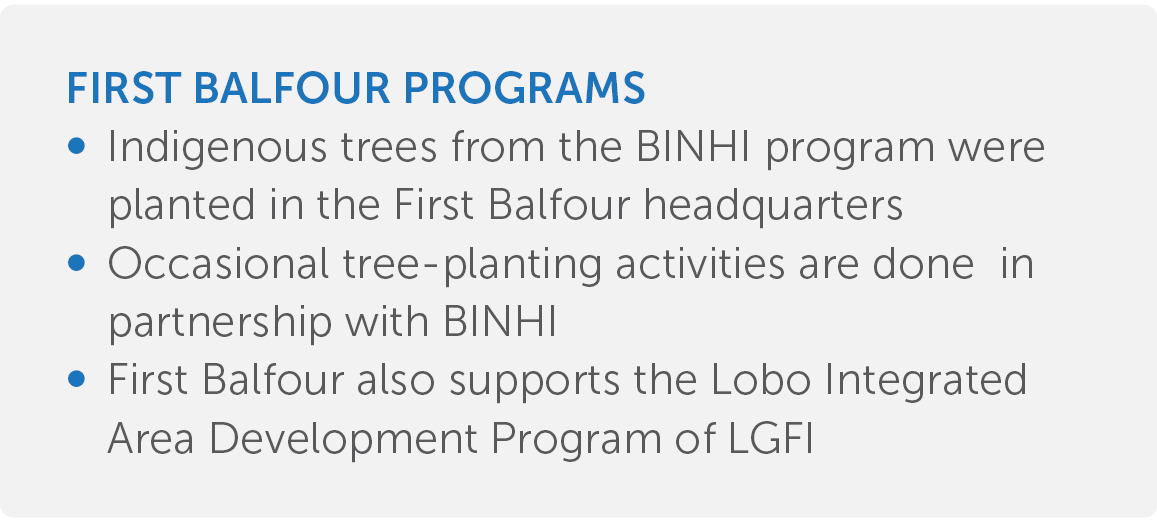
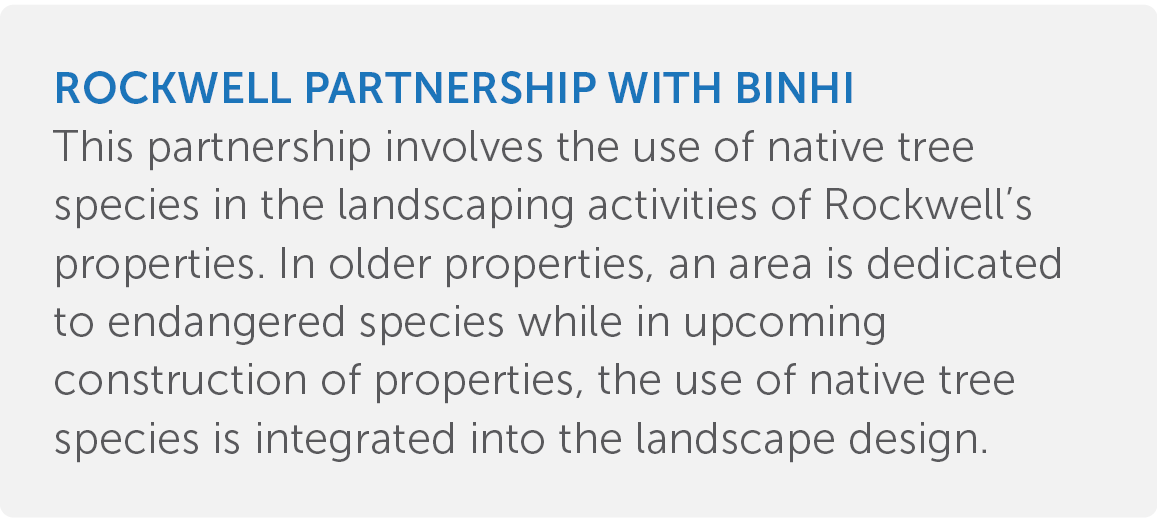
Though our other businesses operate in less ecologically important areas, FPH’s mission for regeneration encompasses helping enhance the integrity of nature, wherever our businesses may be. As such, our non-power businesses work in partnership with the power businesses on their environmental and social programs, as well as having programs of their own.
Summary
• Several capability building sessions were held throughout 2022. For natural capital this included the topics of decarbonization, energy management along with energy audits, and waste management. From these sessions each subsidiary was required to develop related management plans to reduce negative impacts and later on create positive impacts.
• Overall, resource consumption, GHG emissions, and waste generated increased as operations expanded for all subsidiaries due to the opening of the economy.
• Despite this increase, FPH and its businesses are striving to grow in such a way that we can aid our customers and stakeholders reduce their impact on the environment, such as with the generation of more RE, having our real estate properties run on RE to reduce the electricity-related emissions of tenants, and reducing emissions of the electricity distribution grid by using clean and efficient transformers and energy solutions.
Non-Financial Outcomes
• There was an increase in natural capital with regard to the availability of fuel supply for our natural gas and geothermal assets. This however is outside the control of the company.
• Overall, the consumption of materials and generation of emissions and waste increased, thereby decreasing our natural capital. However, the trends on these vary per business segment.
• For biodiversity and habitat protection, there has been an increase in natural capital.
Financial Outcomes
On one hand, the increase in supply of fuel for power generation led to increases in revenue. On the other hand, the efficient and responsible utilization of resources—in synergy with other capitals—also contributed to the increase in revenue.


