

Residential and Commercial Real Estate

Rockwell Land Corporation (Rockwell Land) is a pioneer in developing master-planned residential and commercial communities where residences, workspaces, and lifestyle hubs are integrated. Each development is carefully planned with the company’s signature innovation, exclusivity, and quality. Rockwell Land continues bringing its luxury lifestyle brand to more key cities outside Metro Manila.
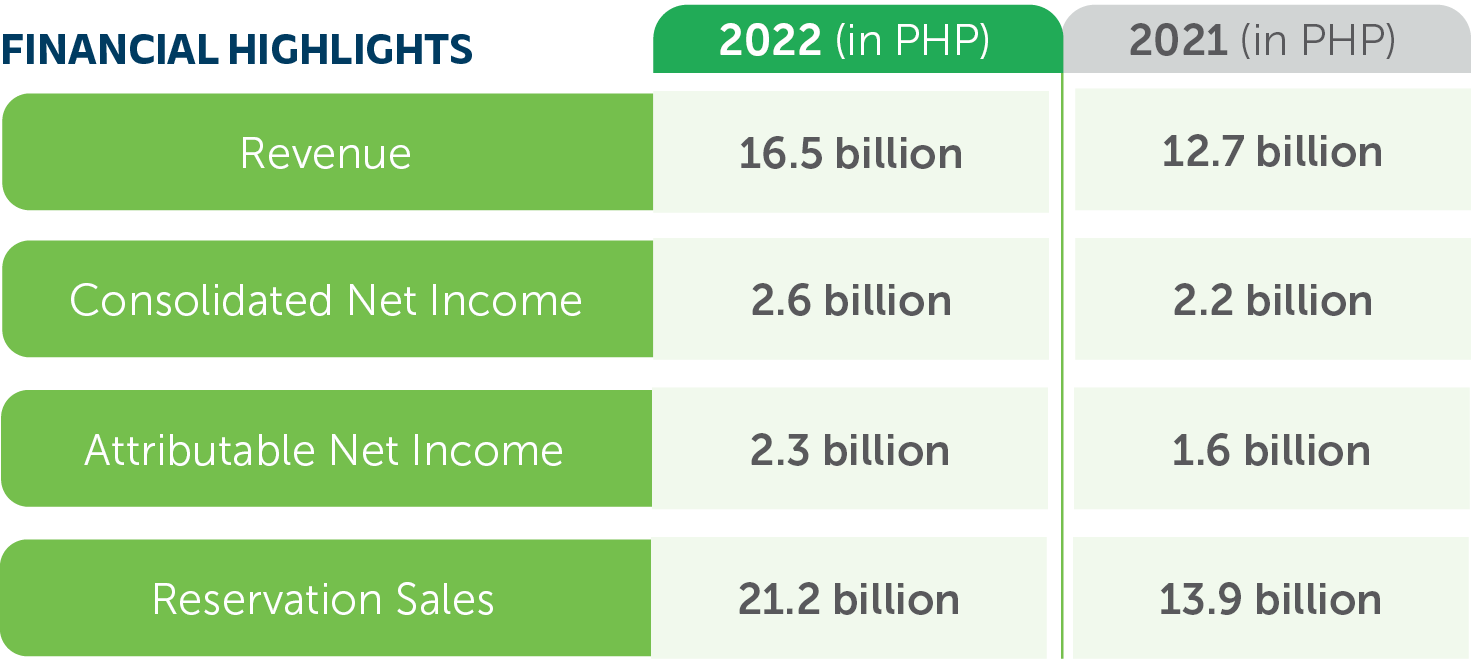
In 2022, Rockwell Land recorded a consolidated net income of PHP2.6 billion, an 18.2 percent increase from the previous year’s PHP2.2 billion, mainly due to higher revenues in all segments and increased construction accomplishments.
Total revenues for the year reached PHP16.5 billion, up 29.7 percent from PHP12.7 billion in 2021. Meanwhile, earnings before interest, taxes, depreciation, and amortization (EBITDA) rose to PHP5.4 billion in 2022.
Demand for Rockwell Land developments soared in 2022, with reservation sales amounting to PHP21.2 billion, a 52.5 percent increase from PHP13.9 billion in the previous year. Reservation sales from new launches contributed around 37 percent of Rockwell Land’s net reservation sales in 2022.
Key Highlights
Rockwell Land completed 1 Proscenium, 32 Sanson-Solihiya, and The Vantage West in 2022.
In 2022, Rockwell Land unveiled five developments - Edades West, Rockwell Business Park, The BenCab at Rockwell Center Nepo, Bel-air, and Terreno South Phase 4.
The retail business recovered quicker than anticipated as pandemic restrictions eased, while luxury residential growth remains robust due to high potential investment appeal. Furthermore, there is high demand for horizontal and regional development.
Occupancy in Rockwell Land’s office developments dipped slightly from 96 percent in 2021 to 95 percent due to some pre-terminations as well as the additional gross leasable area (GLA) of 1 Proscenium. However, rental rates improved as Rockwell Land was able to secure escalations from renewed tenants. Meanwhile, retail occupancy has improved in 2022 to 90 percent compared to 76 percent in 2021, as there were fewer restrictions in 2022. This, therefore, allowed existing tenants to continue operations while new tenants were able to open. Rates significantly improved on the back of better sales driven by increasing foot traffic year on year.
In 2022, 1 Proscenium was added to Rockwell Land’s Office Business unit portfolio, providing 5,760 square meters (sqm) and bringing the total portfolio size to 151,376 sqm.

Looking Forward
In 2023, FPI plans to continue building on its new business initiatives. The organization aims to balance efforts between its core and new business products, with a slight prioritization on introducing non-transformer products to customers beyond the Meralco market, such as electric cooperatives and distribution utilities in Visayas. It is also looking at potential markets with similar technical alignments in Southeast Asia, to further strengthen their export business. Moreover, FPI is planning to make investments related to battery storage and is currently in active discussions with local and international companies, including experts from Japan, for this investment opportunity.
FPI will focus on building capabilities that enhance value to customers, especially in the market and plant areas, and developing a culture that can adapt to changing environments. FPI will continue to drive its digital transformation and capabilities as it moves into a new era of business.
In a volatile, uncertain, complex, and ambiguous (VUCA) world, FPI believes its products will be well-suited to meet the current and future needs of its customers, especially if they address pain points caused by extreme weather, higher penetration of renewables, a hotter Philippine climate, and the impact of electrification of transport.
As extreme weather events become more frequent and severe, it could lead to an increased need for transformer replacement or repairs due to accelerated deterioration of transformer components. This could provide FPI with a potential new revenue stream and an opportunity to innovate and develop new solutions to address these challenges.
The potential widespread adoption of electric vehicles (EV) that require fast charging systems can also accelerate the aging of transformers, reducing their lifespan. EV chargers have electronic components that can generate harmonic loads on the transformer, which can cause overheating and potentially damage the transformer. Aside from this, the increasing penetration of Distributed Energy Resources, particularly solar, can lead to higher voltage stresses on the connected equipment, such as transformers. Additionally, the reverse flow of power during the feeding-in of solar energy to the grid can cause overloads to the transformer if not properly monitored and mitigated. These developments pose an opportunity for FPI to improve the technology and performance of its products to be better prepared for these changes in the market.


