

Industrial Real Estate

First Philippine Industrial Park, Inc. (FPIP) is one of the Philippines’ largest and fastest-growing industrial parks today. With over 600 hectares of prime industrial land, it is now the preferred location of 150 world-class locators. FPIP was established in 1996 in response to the government’s call for private-sector assistance in catalyzing industrial growth. Today, FPIP continues to work with its locator partners in contributing to national development and economic growth by helping generate nearly 80,000 local jobs and billions of pesos in annual export earnings.
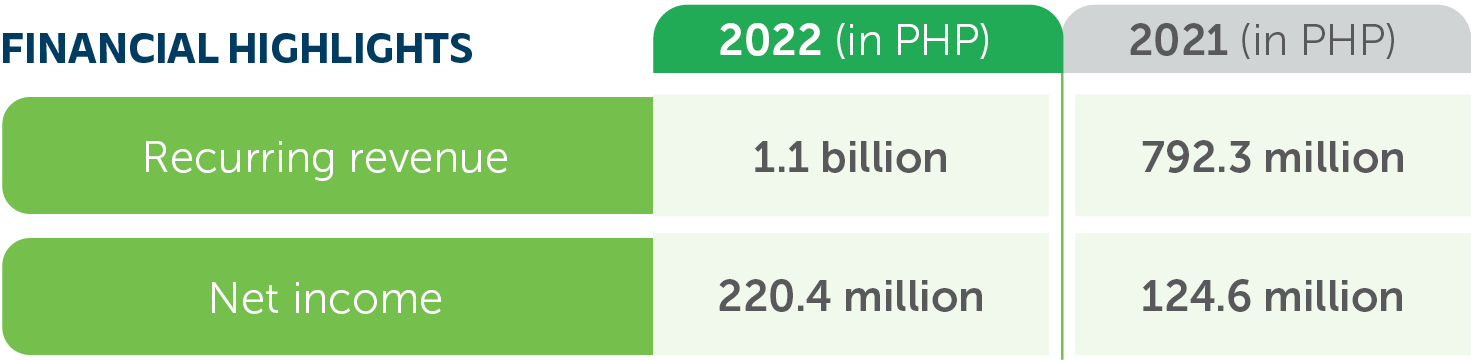
FPIP ended the year 2022 with favorable operating results, exceeding both its revenue and profitability targets for the year. FPIP’s recurring revenues increased by 42.9 percent to PHP1.1 billion from PHP792.3 million in 2021. The growth was largely driven by new lease contracts from new industrial locators, higher water volume consumption among locators, and annual water tariff adjustments, which started in 2021.
In addition, FPIP’s net income grew by 76.9 percent to PHP220.4 million in 2022 from PHP124.6 million in 2021, while its water revenues registered a PHP170.1 million increase or 79.3 percent growth from 2021 to 2022.
Key Highlights
FPIP continues to attract global industry leaders as new anchor locators and to support current locators in their expansion plans. These will contribute to growing export revenue contributions, currently at USD3.5 billion, which is a testament to FPIP’s commitment to elevating the industry.
In 2022, FPIP welcomed seven new locators, including TE Connectivity, a top manufacturer of electronic connectors and devices with the potential to bring in technology transfer and employment opportunities. Through these new locators, FPIP increased the total number of jobs generated from about 70,000 in 2021 to nearly 80,000 in 2022.
Despite the challenges faced during the COVID-19 pandemic, FPIP ranked first in terms of cumulative new and expansion investment values from 2017 to 2021. FPIP has expanded its lease offerings with the addition of a 31,633 sqm - fully-fitted building that is readily available for occupancy, as well as 10,608 sqm of ready-built factories (RBF) space. These latest additions bring the total RBF lease area to more than 184,529sqm.
At a time when job losses were mounting globally due to the pandemic, FPIP saw a 25.5 percent increase in park employee headcount versus the pre-pandemic period, a testament to its commitment to creating both jobs and an inclusive workplace.
Consuelo Park Residences, FPIP’s first dormitory complex, welcomed its first batch of residents at the start of 2022. Located just 100 meters from the Consuelo R. Lopez Park is phase 1 of the complex, offering secure, convenient, and affordable living facilities within the industrial estate. Additionally, new consumer business pilot runs are also ongoing to provide food and beverage and financial services to FPIP’s tens of thousands of employees.
The township community project, which was originally designed by Singapore-based urban planner, Surbana Jurong, is undergoing further refinement with Boston-based urban planning expert Sasaki & Associates. These refinements include better integration with the industrial park, embracing the San Juan River, improving accessibility to local and regional communities, expansion of open spaces and public parks, and improving regenerative and inclusivity concepts.
FPIP also recognizes water as a critical resource for sustainability and growth. To strengthen its focus and capability in water management, FPIP established the Water Resource Management Group in 2022. The group leads all water resourcing initiatives, including usage studies, revenue management, regulatory compliance, stakeholder engagement, and other related operations.
FPIP’s park population exceeded pre-pandemic figures driven by additional locator manpower requirements, notably from current locators as operations stabilized. Moreover, FPIP’s hotel revenues were up by PHP8.2 million from 2021’s PHP14.3 million, or a 57.3 percent growth versus the previous year, showing signs of recovery.
FPIP, in partnership with First Balfour, Inc. and First College, extended community assistance by providing 10,000 COVID-19 vaccine donations to the host communities of Sto. Tomas and Tanauan and through the rollout of its #KaVax communications campaign. This sped up the full inoculation of locator employees and members of FPIP’s host communities. Today, 98 percent of all locator employees have been vaccinated, helping stabilize locator operations and improving employee attendance and headcount.
In 2022, FPIP was awarded the Best Practices in waste management awarded by the DENR in recognition of its continuous efforts to protect the environment. This is FPIP’s fourth award in four consecutive periods.
Looking Forward
FPIP will continue to expand its land bank and assess the best use of available land in 2023, including reconfiguring areas within the park to further increase recurring revenue through a combination of industrial and commercial land and property lease.
In addition to this, FPIP is expanding its menu of products or services and is on track in its viability studies for the following:
- Warehousing and logistics services. Given the continuous influx of investments within the region and increasing land rates for manufacturing, FPIP is exploring built-to-suit and speculative warehouse options within and outside the park for proximity to production.
- Waste Management Services. FPIP is also exploring offering waste management and treatment services to locators and potentially to outside businesses. In partnership with multinational engineering firm Arup, FPIP has ongoing confirmatory studies to determine the commercial viability of the business, which is expected to wrap up by 2023.
- Digital Infrastructure. Digitalization has been accelerated by the pandemic and has become part of everyday life. FPIP is working on enhancing the digital experience in the park, through platforms such as locator and consumer portals and facility access management systems.
- Unified Group Offerings. In line with the goal of providing an enhanced product and service portfolio, FPIP seeks to extend the products, expertise, and services offered by the FPH group to existing and prospective locators.
- Recruitment Partnerships and Programs. To address the growing manpower demand, FPIP will partner with manpower agencies and potentially establish its own. It will also ramp up its digital platforms and recruitment efforts through referral programs.
- Consumer services. To further improve the park and locator experience, FPIP will introduce a consumer portal offering various potential services such as financial solutions, healthcare services, talent services, consumer goods, e-commerce, and real estate.
Various stakeholders believe that ASEAN is in a good position to benefit from the tailwinds favoring ASEAN manufacturing, leading to significant growth in the next decade. ASEAN’s foreign direct investment inflows will rise due to its growing market of 660 million consumers, including a rapidly expanding middle-class with increasing purchasing power, and the rolling out of manufacturers’ China+1 strategy as a workaround on the trade ware fallout of China and the US. The COVID-19 pandemic has also helped accelerate the establishment of satellite manufacturing facilities across the ASEAN region.
FPIP will strengthen its partnerships with government investment promotions agencies such as the Philippine Economic Zone Authority (PEZA) and the Board of Investments (BOI), interface with parent company Sumitomo Corporation’s network and sales arm to attract Japanese locators who are seeking to diversify their supply chain by presenting FPIP’s industrial offerings, and actively engage with chambers of commerce, industry associations, and its current locator network.
Aside from the manufacturing sector, another industry that FPIP is looking for opportunities in the Information and Communications Technology (ICT) industry, to which Business Process Outsourcing (BPO) activities belong. This industry has captured USD6.5 billion worth of Philippine investments. FPIP recognizes the potential of this untapped industry and is exploring future offerings for this sector.


